<Music begins> 00:00
INTRO 00:04
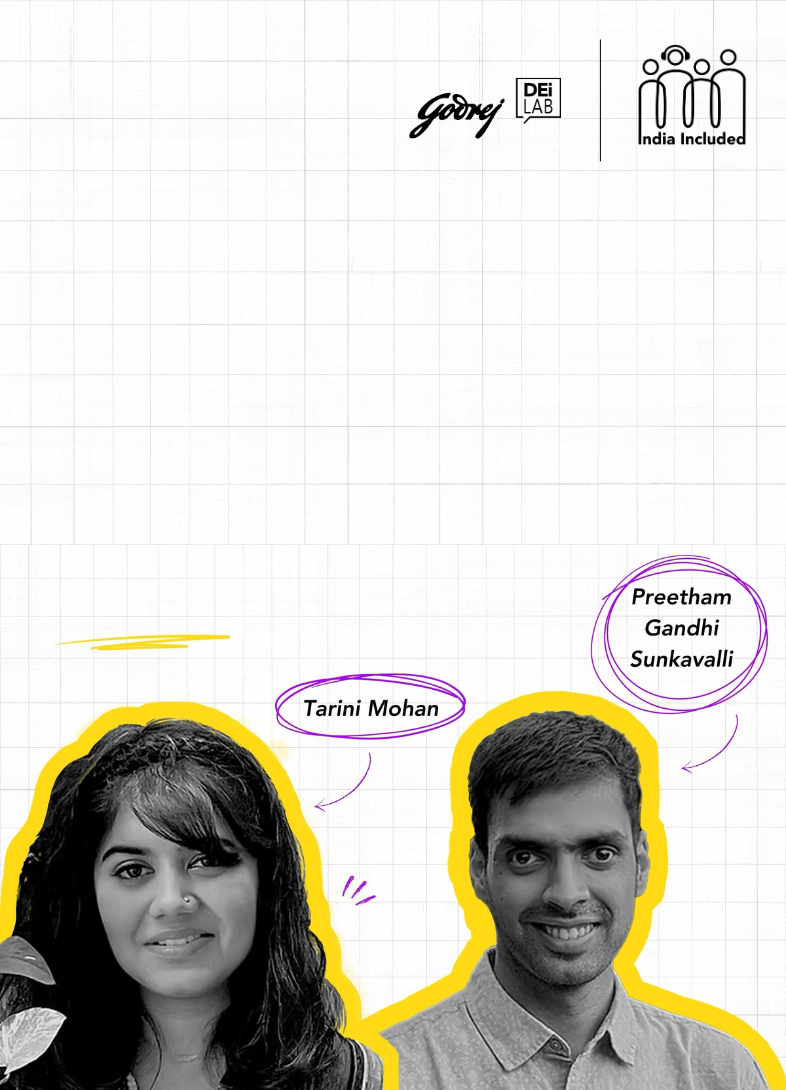
From the Godrej DEI Lab, welcome to India Included. In November 2025, we teamed up with the wonderful folks at the Mumbai Lit Life Festival to curate sessions that brought reading, writing, and literature into conversation with our vision for a more inclusive workplace and world. This episode is the recording of a conversation with Tarini Mohan, author of a brilliant memoir, Lifequake. She was in conversation with our own Pritam Gandhi Sunkawarli, Deputy General Manager Brand at Goodrich Consumer Products Limited.
<Music ends> 00:46
Preetham Gandhi Sunkavalli 00:47
Thank you, ladies and gentlemen, for being here. Welcome to the session. I've read the book, and I've been in touch with Tarini for a few weeks. And it's so interesting, because there are so many things that you would think that an experience like this is not something you could relate with, but I'm pretty sure by the end of the session, that notion will change. And Tarini?
Tarini Mohan 01:11
First of all, thank you all for being here. Thanks so much for coming. Before we begin, I would like to give a shout out to my niece, Inaya, 18 year old niece who came all the way just to hear me speak. Thank you, Inaya.
Preetham Gandhi Sunkavalli 01:32
So, shall we jump right into it? Yes, So would you like to tell us what the definition is and why you chose this, why you chose Lifequake for your title?
Tarini Mohan 01:42
Yeah, okay so like usual I was listening to a podcast while biking one day and I heard an interview with an author Bruce Feiler who was talking about his book Life in Transition or something I forget the exact name and he coined the term lifequake to mean a period of major disruption in your life. It can be positive or negative but it changes the way you experience the world and yourself. And that is so far my motorcycle accident in Africa in 2010 - I had a traumatic brain injury and it changed my whole life.
Preetham Gandhi Sunkavalli 02:37
This book, as the introduction said, is deeply personal and you've not hesitated in sharing, of course the successes but also the struggles and the difficulties that you faced over this journey. So can you take us through your writing process? How do you write about something like this? How do you be so honest and not sugarcoat because most of us have the tendency to do that?
Tarini Mohan 03:04
That's why, the thing is that first of all, it's a weakness of mine that I am a bit too honest. I never hesitate before just saying the true side loud whether it's polite or not. But in this case, telling the truth felt like... After writing about trauma, it felt like honouring reality. And so, even though it wasn't too... sometimes in certain paragraphs, I want to... weren't exactly... tries to write, it's just the truth. And the notthing I can do, why you trying to sugarcoat it? I mean, who does it benefit?
Preetham Gandhi Sunkavalli 03:58
And you did mention in the beginning of your book that so much of what you've written are, you know, they are a result of honest conversations that you've had with your loved ones, with everyone who was around you at that time. And, not only conversations, but also emails and text messages. And it's so authentic to actually read these conversations, these deeply personal conversations that you opened up to us. But I do want to get into the theme of the book. So you mentioned that the theme of the book is hope and love. And we will get into love later in the session. But for now, can you talk us through hope?
Tarini Mohan 04:36
Okay, yeah. So hope can come in many different forms. Not just in optimism, though that is the most common. For me, even though it looks like optimism, some friends say that I am the most pessimistic person they know. So I don't know what the truth is. But for me, hope manifested, in actions - in me applying to Yale University after my severe traumatic brain injury. Thus, having the will and determination to keep on living. So that's my hope. That's my hope and...
Preetham Gandhi Sunkavalli 05:27
Now, it's very interesting what I'm going to do with the audience now. And apologies, Tarini, for asking this question. But how many of you find this inspiring? Can you please clap if you find it inspiring? OK. Now we have a problem. Because the first conversation Tarini and I had over text is about inspiration and how we both do not like the term inspiration. We both have very strong views on inspiration. And I'd like it if you could share them.
Tarini Mohan 06:01
Before I go on, I just want to say, but I fully acknowledge that it comes from a good place. And I'm very grateful for that. But at the same time, reflects society's discomfort with engaging with disability as a concept. And I'm living with the ambiguity of difference. They just do not want to engage and it's simpler to just show a quote and say, "Oh, that's inspiring." And people who don't know a thing about me and who are seeing me for the first time say, "Oh, I'm so inspired." Just because they see four wheels on my wheelchair, I'm like, "Are you inspired by wheels?" I just find that 'inspiring' also flattens my identity.
Preetham Gandhi Sunkavalli (07:01
Yep.
Tarini Mohan 07:03
Like, I'm an author, a development professional, a silly human, a lover of rom-coms. I'm not always inspiring. And just depending on the day, I may be really inspiring, but that's just at the point.
Preetham Gandhi Sunkavalli 07:28
Absolutely. And that's why we use person-first language, right? We don't want to be defined by our disability. Especially when folks use terms like differently abled, specially abled. People with disabilities are not different or special. They just have a disability. And you say 'persons with disabilities' because we are persons first. We are multidimensional. She's a development professional. I'm a corporate executive. We have so much more that defines us than just by the fact that she uses a wheelchair and I use a cane. But yeah, let's get back into the book. So you've gone to Wellesley College. You were working with Morgan Stanley in New York City, living the life. You described your New York City life as something like Friends, the sitcom. And it's amazing, because that's the dream, right? That is the dream. But you wanted to get into the development sector. You quit your high paying job making rich people richer. And you decided to move to Kampala, Uganda. And there you made the most of it. You were working on helping marginalized farmers. You had an active social life. And when you were going to a party like that, you along with a friend were on a boda boda. I hope I said that right.
Tarini Mohan 09:00
It's like a taxi.
Preetham Gandhi Sunkavalli 09:01
It's a motorcycle taxi. You both were not wearing helmets. The driver was. And what you think was an SUV hit you guys from behind
Tarini Mohan 09:11
And drove off.
Preetham Gandhi Sunkavalli 09:12
And drove off. Hit and run. What happened?
Tarini Mohan 09:16
Well, so immediately after... nothing happened for around, I don't know the exact time, like 10 minutes or something. Are we, that is still remains unknown. But after a little while, some police officers are standing at a distance. They had overhead the crash. They came and found three bodies, two unconscious and one man was in pain, the driver. It was the driver in front, me in the middle and my friend at the back. So then an ambulance was called and we were rushed to ER at the biggest local hospital, Mulago Hospital in Kampala where they were extremely crowded ER, extremely crowded. As I hear from my friends, there was not a... there was not a patch of visible space to be seen. There were people, there were patients lying on the ground. And the ratio of nurses and doctors to patients was extremely low. So they were... My friends came when they heard. My friend kept calling me, but our phones had... our phones had fallen off. When we fell. At long last, a police officer found my phone. And he answered, my friend, Ugandan friend was waiting at the bar for both of us. And he said...He was expecting me to answer and he was mad. We were so late. He wanted to give me a firing but luckily I only had a... He couldn't do that. So the police officer told my friend there has been an accident and my friend said, "Oh my God, are they safe?" And he said, "We don't know." Then we took them to ER. he and my other friend, my new friends of six weeks, I only been in Uganda for six weeks. They rushed to the hospital and they just stuck by me and my friend from there, they're just stuck by us. They didn't leave our sides.
Preetham Gandhi Sunkavalli 12:22
Let's talk about Kampala itself. And there's a very interesting factoid that you wrote in your book, which is that half of the entire force of neurosurgeons in the country of Uganda was on your case at one point.
Tarini Mohan 12:39
Yes.
Preetham Gandhi Sunkavalli 12:41
And the total population of neurosurgeons in Uganda at that time was four.
Tarini Mohan 12:46
Yes.
Preetham Gandhi Sunkavalli 12:48
Now it's 13. But can you tell us, I mean, since you worked there, can you tell us about the realities of medicine in Uganda and generally Uganda itself?
Tarini Mohan 12:59
Oh jeez. If I had been there, if I had continued on with my plan of living there for one year, I would have much more knowledge about the country than I do at present. I just know the basics that all of you also must know. That things are bad, it's a very poor country. And just that the ratio of skilled doctors and nurses is very low.
Preetham Gandhi Sunkavalli 13:33
So now let's get back to the aftermath, right? Your parents, your entire support system mobilized. There are, you've written, and you've basically pieced together what has happened, the way your parents reacted, the way your partner reacted, the way the whole ecosystem, your friends, the way your brother was informed. So how did your family mobilize? What happened then?
Tarini Mohan 14:03
So somehow my family, each of them responded in ways that are just quintessential of their personalities. The immediate reaction, they needed to find out more about exactly what happened. And when my father was making phone calls, to all the people he knew to find out who knew somebody in Uganda who had connections in the medical field in Kampala and stuff like visas and things. My mother was busy packing the suitcases, thinking of whether they would need a jacket, packing all kinds of shoes and things like that. And of course, my brother, poor fellow was partying in New York. And my parents didn't want to spoil his night of partying, so they decided to hold back. No, actually they were trying to phone him but he just wasn't answering because obviously he was in a loud bar. But then, luckily, my brother was with his UWC friends. So UWC is my school, United World College. So he was... my brother also went there because he's a copycat. So he was partying with his friends. And one of his friends is my friend's little sister. So she heard through her sister. And then my brother called my parents. But then my dad had already got a network of people who had connections to somebody or the other in Kampala and different doctors and nurses. And at that time my dad was teaching one semester a year at Yale and the president of Yale gave him so much support. He said, "You go, you go, you're not needed here. Because in such a moment, there's more you can do. You have other responsibilities." So he had the freedom to come to, to fly to Uganda.
Preetham Gandhi Sunkavalli 17:06
One thing we should acknowledge, you should, I should, and most of us should in this room is privilege. The kind of connections your family had, the resources that they were able to mobilize in Uganda, the way they moved you back to India, back to Delhi. A lot of this happened because of privilege. So what's your read on privilege?
Tarini Mohan 17:30
So my view on privilege is that fortunately... it's just luck like who you have the privilege of the family you are born into and I have the privilege of being born into my parents who are extremely social in good way, not in a kitty party way. And they have a very good social capital, which they nurture. And not out of, "Oh we need a network", but just because I think that they just come naturally to be good to people. So I guess that's why people like them, except for when my mom... Okay, I wont'... i just can go on and on. Whenever I was a teenager and I used to take dance classes with my mom and she was quite evil then. I just had to, sorry mama.
Preetham Gandhi Sunkavalli 18:57
Tell us about your friends, tell us about Pallavi, tell us about your school friends. It was so nice for me to read about, know, because I am also privileged that I have a group of very close friends who would be there for me throughout. And they did play a significant part in your initial recovery. So, give us a peek into your friend group.
Tarini Mohan 19:21
Thank you. There's nothing I love more than talking about the whole concept of friendship. Friendship has been the architecture of my healing. And not only my healing of, I guess, of healing in general. Love and friendship. So, well, I'll first say that in terms of who all were there for me as a time of my accident recovery, initial recovery also had a lot to do with geography because many friends who... I was not in touch with the during my initial recovery. Not because they didn't want to, but just because they were so far removed. And if they have been closer, there's no question that they would have been there. And that's true for all of us with our friends who are close or far. So, at the start, at the start, my friend, my friend Himali - she went to my school from class three onwards. And then both of us went on to UWC Pune for class 11 and 12. And then we both moved to the US for college. And then once we graduated, we moved to New York City. And she's an artist. And at the time I was working in finance. So we were treading very non-overlapping paths. But we still met up every weekend, every weekend back then because, I mean, early 20s, nothing to do. So we met up every weekend to wonderfully markets in Brooklyn and go for brunches and go to Himalaya's house for a home-cooked brunch. It was really fun. But then, at the time of my accident, she... she was in Delhi then and she showed up, like she was there a lot. Like the hospital almost became her second home. She would come just to give my parents relief in the hospital, just so they could go home and sleep. So much so, that my dad said they're calling her number two. I'm number one. I don't know if it's me or my mom, but surely it's me. Yeah, so there's Himali, there's my other friend Sahil, who is just a clown. He just lightened everyone's moods and he would come to visit me in my early recover and he would ask me what I wanted and he would bring me hot chocolate fudge.
Preetham Gandhi Sunkavalli 23:07
I love hot chocolate fudge.
Tarini Mohan 23:09
Yeah, tell me about it. So one day, he asked me, "What do you want?" And he shouldn't've asked because I said I want hot chocolate fudge. And he brought me hot chocolate fudge. But then everyone who, lots of friends would come and see me and everyone asked "What do you want?" And I was saying hot chocolate fudge to everyone. So one day, my dad counted, I had, you won't believe it, I had 13 hot chocolate fudges back to back. So my father, I told my dad too, when he told me "You're eating too many desserts," I had said, "I don't believe you because I didn't even have sweet tooth." So you're just fudgy, I guess. So then I told him, "Prove it". So one day he sat at the corner of my room counting. And he counted 13 and he held up the paper with the number 13 written on it and showed it to me. And then from that day onwards, I have gone off sugar completely. I still don't eat sweets except for my birthday. Because come on, with limited mobility, I'm told to be two... I don't want to become more obese. I don't know, is that politically correct?
I guess not.
Preetham Gandhi Sunkavalli 25:06
I don't know, my coping mechanism is still sugar and chocolate. I do want to ask about Nikhil.
Tarini Mohan 25:14
You may
Preetham Gandhi Sunkavalli 25:16
Thank you. Would you like to tell us about him?
Tarini Mohan 25:20
Yeah, okay, so... Nikhil is my partner in my memoir, in Lifequake who I met in, who I met when I started college. Yeah, I went to an all women's college but my Wellesley is in Boston and MIT in Harvard are right there so how does it matter if they're not on campus? So... Nikhil and I met within two or three months because a friend of mine found a band with him and one day I went for my friend's concert and I saw this dashing, sharp guitarist playing a solo and he was just so fine. I totally fell for him and not only was he a musician, he was very smart. So we started going out gradually in 2004, first day of college and we were still together by '08 when I graduated and then we both moved to New York and so we had been together for five years by the time five, six, five, six years by the time I had by the time my accident. Five, six years so I guess it was anybody's guess whether he was still with me or not. I won't give it away
Preetham Gandhi Sunkavalli 27:06
And you know, it's very interesting because one movie I would strongly recommend is this movie called Sparsh. It's a 1980 movie with Naseeruddin Shah and Shabana Azmi. Naseeruddin Shah is a visually impaired principal of a blind school and Shabana Azmi is a widow. And so much of it, and the reason I related to it so much and the reason I pretty much broke down every 15 minutes while watching the movie, was because of not only the characters but also the insecurities of Naseeruddin Shah that come out really well. Because you don't know, you know, "is she with me because she actually loves me or is she with me because she's sympathetic and she just wants to help and she wants to be nice." And you know, there are articles, there's one brilliant, another brilliant article called 'I Need a Lover, I Don't Need a Nurse.' That's what makes this so interesting. I would strongly urge you to read the book, to get the entire story and to know what happened. I don't think that there is enough representation of love, at least in this context on print. So thank you so much for sharing that story. I don't think it would have been easy for you to reflect on everything and put it down.
Tarini Mohan 28:28
Luckily, luckily, Nikhil was great. He was reading every draft of my memoir. And he was totally fine with me using his real name. But then I decided to change it anyway just to protect him. So yeah, Nikhil's got a real name.
Preetham Gandhi Sunkavalli 28:53
Aha, okay.
Tarini Mohan 28:55
But we're still like best friends.
Preetham Gandhi Sunkavalli 28:59
Cool. So let's change gears a little bit. Let's literally, I mean, let's talk about chairs and let's talk about how you essentially built your life back together. How you became productive, you became independent. So one thing is usually with stories like this and with many such stories. People assume that it's all about medical science. It's all about the treatments. It's all about what doctors can do. But of course, there's so much more to it, right? So would you like to tell us about the years that you took essentially to build back?
Tarini Mohan 29:40
Yeah, that's a very insightful question. So the acute phase of my recovery, the acute phase, yeah it was very medical and it relied mostly on neurologists and physical, occupational and cognitive therapists to get me up to a certain standard but then after a year and half when it became obvious that I reached a certain plateau I guess and the secret is that there is never a plateau it keeps even if the slope is very gradual very gradual like 0.1mm it keeps improving so never give up hope but also keep trying.
Preetham Gandhi Sunkavalli 30:40
So what's interesting is that you've gotten therapy here in India as well as in the US. And one thing that even I've noticed, I've also taken quite a bit of orientation mobility training, independent skills training in India and the US. The US really emphasizes on, while India does of course emphasize on skill building, the US emphasizes on independence. And one great example of that that you've quoted in the book is the skill to hook your bra one-handed.
Tarini Mohan 31:12
Yes.
Preetham Gandhi Sunkavalli 31:13
So would you like to tell us about what independence means to you and how your life in New Haven really, ⁓ you you valued that so much because of the independence there.
Tarini Mohan 31:26
Yeah, so, New Haven was mostly about... I moved to New Heaven because when my dad was teaching once a year, we went back and forth back then from New Haven to Delhi, New Haven to Delhi. So then I would have therapy there and here. So the difference was that New Haven was about anonymity and independence, while New Delhi was about familiarity and care and navigating both of these that means something different it taught me not independence or skills but it taught me interdependence. It taught me how to thrive where people help you be independent.
Preetham Gandhi Sunkavalli 32:36
So you did quite quickly, you were laser focused that business school is where you wanted to go. And you did fill out your essays and in fact you did get admitted to Yale in 2012. But you chose not to go ahead, you chose to defer. And you chose to work part time with the organization that you worked for previously before the accident. What was going through your mind when you took such decisions?
Tarini Mohan 33:06
Yale was an amazing experience. Just because of the flexibility that the school showed, they told me when I first decided to defer, sorry, when I first realized that I was, when I first thought I would have to decline. So I summoned up the courage to decline, because originally I thought I would recover in one year, I would be hopping, skipping, jumping, because I had never ever experience recovery taking so long in anyone. It just shows the positive of my own experience. So when I told them and I told them, "Yale, sorry I have to decline because I need rigorous therapy." They said, "Nothing doing. You go focus on your therapy and come to us when you're ready, we'll hold your seat." So that kind of flexibility is just mind boggling. It opens so many doors. It opens doors. It opens doors and it shows individuals potential.
Preetham Gandhi Sunkavalli 34:58
One aspect that happens in Ivy League MBAs and most top-tier MBA programs is that the curriculum is extremely rigorous and we have study groups and I've also faced this. You don't want to be perceived as a drag and whether people perceive you as a drag or not, you might judge yourself and typically this is something we call internalized ableism. So ableism, kind of like casteism or racism, essentially means that so-called able-bodied people are superior because they have no deficiency. Now, you might think that regular people think this way, non-disabled people think this way, but a lot of us have what's called internalized ableism, where we believe that we are slowing the team down, that we might be, we might not be the asset that we think we are. And this really comes to the fore in an MBA environment, especially with a group where everyone has to pull their weight. So could you tell us about your experience in SOM and how you felt?
Tarini Mohan 36:15
SOM, School of Management
Preetham Gandhi Sunkavalli 36:18
Ah sorry, School of Management.
Tarini Mohan 36:20
Yeah, thanks. So my experience with ableism...My experience with internalised ableism only... first of all, I reckon I came across the term only after I finished my book. I came across the concept and the term and then I reflected and I was like, "Oh, I guess at this time when I refused to go for tutoring, for peer tutoring in school, in college, university - I thought my having to request support, it would mean that I'm less so." But there's nothing wrong with anybody asking for support. It does not make it less. In fact, knowing that you need support like all do, I guess that doesn't make it less. So, and also, internalised ableism while most of the most people with disabilities have some internalised ableism. Ask yourself, ask yourselves to... "Is there some part inside you that makes you think that disabilities are- Do you think of people with disabilities as somehow less than you?" You don't have to anything right now, obviously. I'm not going to interview you, but ask yourself that. And the truth is that I saw... I saw myself as less, less than and so it was clearly internalised ableism and it's gonna be a work in process.
Preetham Gandhi Sunkavalli 38:51
It's very much a work in process for me, as well. So as we get to the conclusion of the session, I'd just like to know about your post-MBA life and what you're up to now.
Tarini Mohan 39:07
Okay, so, after I graduated, I was always intent on working in development but then I decided that it makes sense for somebody like me to work in accessibility. So for one and a half years I was working on accessibility in higher education. But I recently accepted a full-time job in public health, and they're embracing of disability. And at the same time, just choosing another path. It feels like embracing the level of disabled, while at the same time... while at the same time not being boxed in by it. And that feels like real progress to me.
So yeah, so my hope is that I still find some time while working to continue writing.
<Music begins> 40:58
OUTRO 41:02
Thank you for listening to India Included. If you enjoyed this episode, tell us! Please subscribe or follow and leave a rating and review on the podcast app you're listening to. To find out more about us and the work we do, visit godrejdeilab.com. You can find us on Instagram and LinkedIn at godrejdeilab. Stay tuned for more.
