I spent most of my childhood in rural Maharashtra. Growing up in villages meant women in the kitchen and men in the hallways; often joking about the women in the kitchen. Amidst the jokes, a phrase I kept hearing was the “bachat gatt.” When a woman talked about financial matters, I remember people dismissively saying, “Why don’t you join a bachat gatt?” It was derision then. But now, when I look back, I realise bachat gatts, in reality, are a lifeline for many rural women in Maharashtra across social groups.
A “bachat gatt” translates to “savings group” in Marathi. It is a women-led self-help group typically made up of ten to fifteen women. These groups come together every month to pool small amounts of money which becomes a fund from which members can borrow; whether for personal emergencies, or to start a small business. For many rural women, it’s among the first spaces where they can talk about how to manage money.
The bachat gatt is also part of one of the largest women-led mobilisation efforts India has ever seen. It is the cornerstone of women’s self-help groups (SHG) in my state – an area of transformative economic activity. In Maharashtra, SHGs do everything from protecting mangroves to organising last rites for the dead; last year, trans women came together to organise their first-ever SHG. At the national level, women’s Self-Help Groups (SHGs) are anchored under the Deendayal Antyodaya Yojana–National Rural Livelihoods Mission (DAY-NRLM), one of India’s largest poverty alleviation programmes implemented by the Ministry of Rural Development. In Maharashtra, this network is supported by the UMED initiative.
How does the bachat gatt actually work? Sharda Chaudhari, who has worked closely with these groups in our village, Kharde in Nashik district, explained the functioning of one such group. “There’s a fixed date when everyone shows up and contributes their share. If someone is late, there’s a small fine,” she said. “The money collected is put into the group’s bank account. Every six months, the government matches a percentage of the amount pooled by the group. If someone needs a loan—from ₹500 to ₹50,000, depending on what they’re building or fixing—they can borrow from this shared fund. The interest for this is less, but there’s higher security. It works because everyone trusts each other.”
In Samsherpur, a small village located at the edge of the Maharashtra–Gujarat border, I sat in on a prabhag sangh meeting to better understand how bachat gatts work on the ground. A prabhag sangh brings together fifteen gram sanghs, each of which operates at the village level. Every gram sangh, in turn, accommodates up to thirty bachat gatts. As the meeting began, I sat in a corner seeing women from different villages gather, registers in hand, and ready to account for their work.
The meeting opened with a devotional prayer. Then, the prabhat sangh leader began to speak. She talked about how the money pooled in the bachat gatts had been used: some as personal loans for school fees, some to kickstart ventures, and others for business ideas outlined for the future.
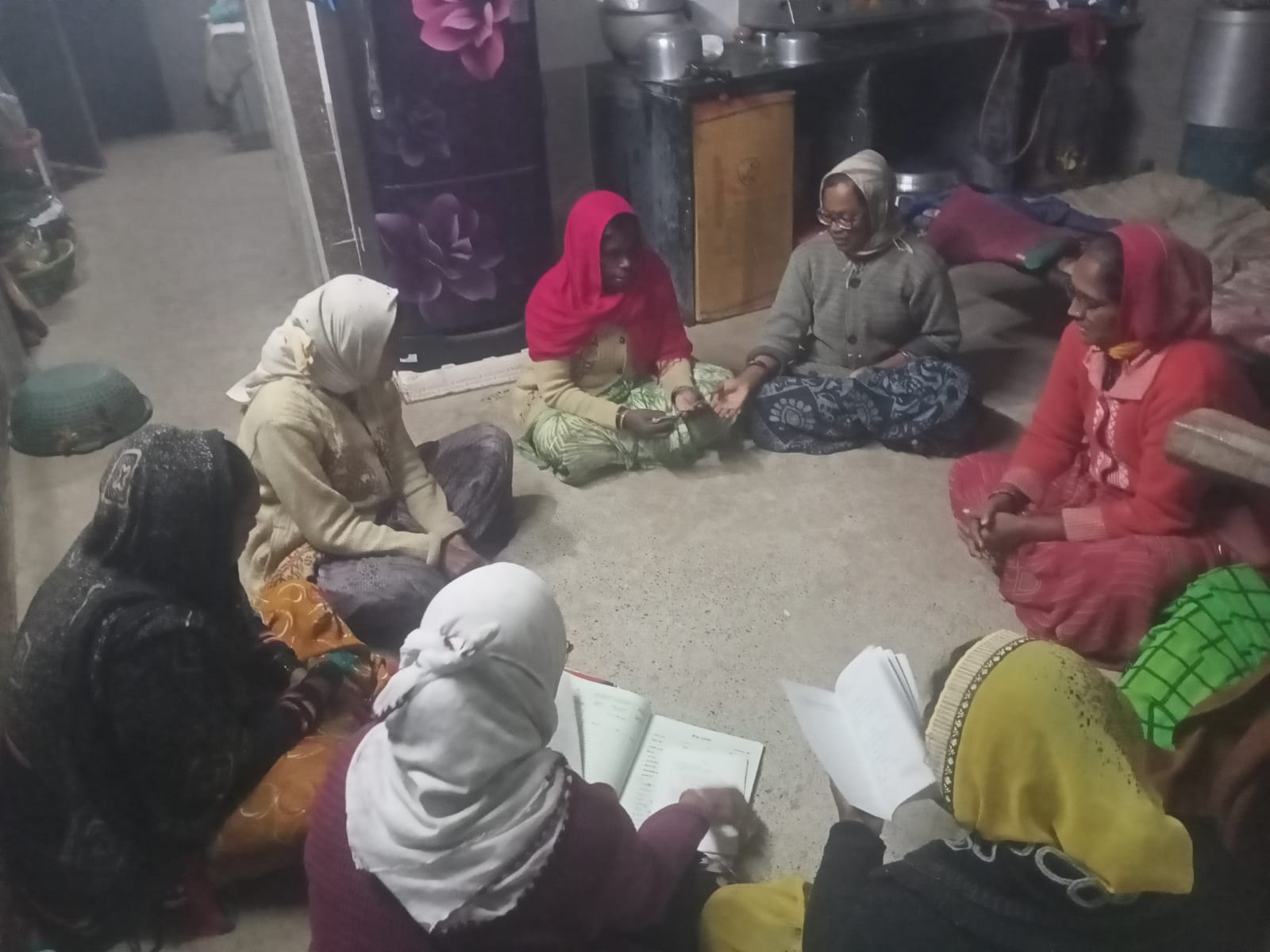
Representatives from each village then took turns to speak: reporting the new number of bachat gatts, the amount of money pooled, and updates on distribution. Some gram sangh leaders brought up women in their networks who wanted to start small businesses, and asked for guidance on how to best support them. Most of these new ideas were food ventures; and representatives gathered suggestions on cost estimates, equipment, and what had worked for women in the past.
With the formal discussion over after a round of updates, the women stayed back to talk among themselves. I learnt that Samsherpur alone has nearly fifty bachat gatts pooling money together. My village, Kharde, which is about 75 kms from Samsherpur, has around thirty. Each of these gatts is supervised by a woman who also works closely with the gram panchayat. This ensures that women are present in spaces where decisions are being made.
What I experienced in that prabhat sangh meeting with a small room full of women is a part of the larger picture. Over the last fifteen years, self-help groups have expanded across 34 states and union territories leading to more than ten crore rural women as part of over 90 lakh self-help groups. This has translated into measurable economic outcomes. Government data shows that nearly 1.48 crore women associated with SHGs now earn at least ₹1,00,000 annually.
UMED, the nodal agency implementing the Maharashtra State Rural Livelihoods Mission, was launched in 2011. Today, it supports close to 4.8 lakh women-led self-help groups and over fifty lakh families, across more than 40,000 villages. It has supported establishing over 87,000 non-agricultural enterprises through SHG-linked programmes, while more than 32 lakh families have been connected to agriculture-based livelihoods.
To me, growing up among women who derive so much meaning and dignity from their participation in bachat gatts, the impact has always gone beyond numbers. In Raimoha village in Maharashtra’s Beed district, through the Asmita Plus initiative, SHGs supply sanitary pads at ₹5 per packet to adolescent girls. And then at Pune International Airport, the UMED Savitri outlet, operated by SHGs under the Pune Zilla Parishad, brings rural products into one of the most elite retail spaces in the city. Handbags, ornaments, honey, and local foods now sit in an airport store, meeting urban consumers on equal footing.
To better understand how UMED works, I spoke to Shefali Gupta. She is a Block Manager, Financial Inclusion at Vasai Block, in Palghar district at UMED MSRLM, and handles funding options within her block for self-help groups.
“Self-help groups provide a system that covers basic livelihoods for women, and empowers them to earn their own money so that they are self-reliant in terms of financial security. This way, they can generate their own livelihood activities,” she said. She described UMED MSRLM (Maharashtra State Rural Livelihood Mission) and, by extension, self-help groups as the bedrock for rural India. “They do not just provide finance to start a business, but also a network of support,” she added. “The aim is to bring every rural woman into a support system so they can build livelihoods with dignity while strengthening villages and incomes.”
The results of these groups are visible in the stories of women like Mayuri Chotulal Chaudhari. Mayuri joined the bachat gatt scheme six years ago. “I always wanted to stand on my feet,” she said. “I just can’t keep still.” She used to earn a small income tailoring clothes and blouses. When the COVID pandemic hit, everything came to a halt. But for Mayuri, it put something in motion.
During the pandemic, she came across a book that listed different kinds of machines. One of them made khakhras. Mayuri couldn’t afford it then, so she taught herself whatever she possibly could through YouTube. She began experimenting from her kitchen, selling small batches to test the idea. Once she was sure, she attended a three-day workshop hosted by UMED, and presented her plan. With UMED’s support, she set up her business and sold nearly 700 packets on her very first day.
Today, Mayuri owns a warehouse and employs other women to help run the business. Her daughter now studies in Canada, supported by a student loan made possible through her mother’s business. Now, she wants to invest in a generator and automated machines to reduce labour and scale further.
“Earlier, women never went out,” she told me. “Now we attend meetings, speak to officers, and learn things we never imagined we could.” She remembers a time when bachat gatts and her participation in one was not taken seriously in the beginning. She says, “People used to say things, sometimes make fun, and dismiss me. But I kept at it. Now when government officials visit, and I have my own income; no one can say a thing.”
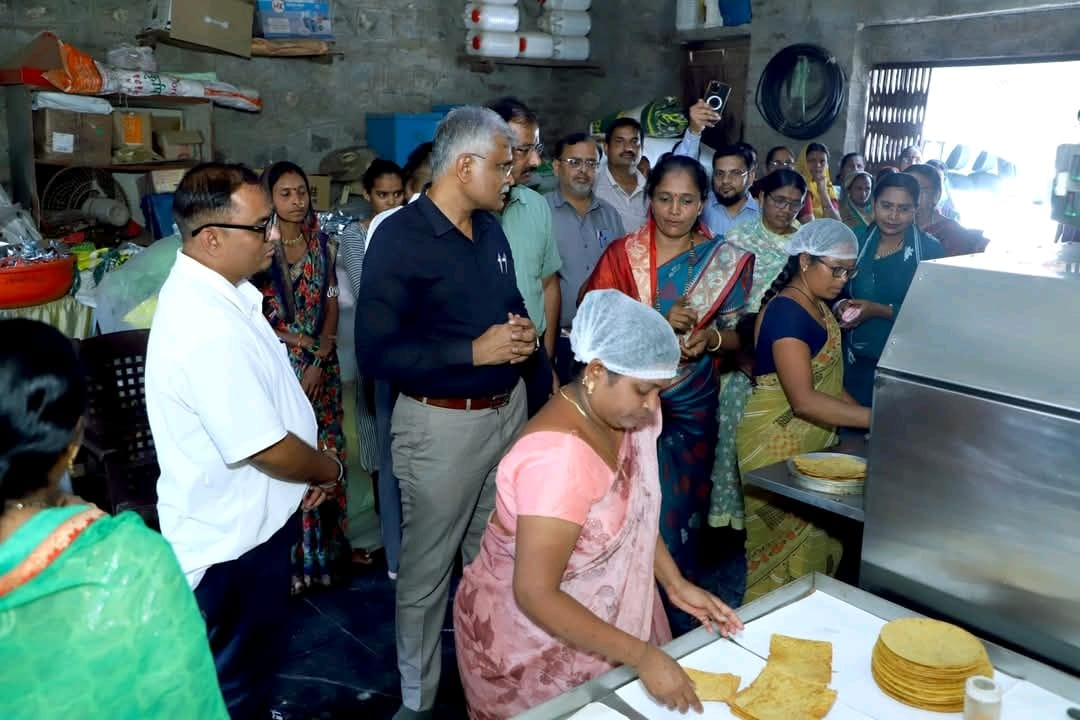
Government officers visiting Mayuris khakhra warehouse
It’s a familiar dismissal. I’ve seen bachat gatts being laughed off as something absurd and minor. But taken together, these SHGs form a network of women who don't want to wait to be included in the economy – they are undoubtedly changing the economic landscape themselves.
A woman who has built something with the help of a bachat gatt has already managed finances, scaled growth, stood her ground, and taken risks. She knows how to negotiate, to collaborate, and to lead. This confidence doesn’t stay contained within the village. It travels with them.
We often look for change in big headlines or public campaigns. But with a bachat gatt, change looks different. Here, it is a group of women sitting in a circle on the floor with a register in hand, quietly building a future for the next generation.
I see that shift in small ways back at home. My younger sister is now taught how to budget alongside usual chores. It is a simple thing, but it says a lot about what is beginning to change. For girls like her, growing up in villages is a different experience, it is where women can step out of the kitchen to discuss finances with the men in the hallways. That small change of setting is indicative of the greater shift these groups have achieved.
Yukta is an intersectional queer feminist artist and writer working in the relm of social impact. They believe in the power of written word to drive positive change and make a more inclusive world one word at a time.
A “bachat gatt” translates to “savings group” in Marathi. It is a women-led self-help group typically made up of ten to fifteen women. These groups come together every month to pool small amounts of money which becomes a fund from which members can borrow; whether for personal emergencies, or to start a small business. For many rural women, it’s among the first spaces where they can talk about how to manage money.
