I was diagnosed with hemiplegia at the age of six months, and from then on, my days have revolved around physiotherapy. My mother and Dr Ashlesha Veer (my physiotherapist) made sure I learned to walk, write, and feed myself. My mother devoted her entire thirties to ensure that I would be completely independent by the time I grew up.
What she could not manage was giving me a social life.
I did not play with other children. I did not have friends over, and I did not go to anyone else’s home. My mother was often exhausted. Managing a full-time job and creating an environment for her daughter to engage in social activities was impossible for her. That early absence of peers left a mark I carried into adulthood.
I learned much later that my experience was not unusual. Many people with disabilities grow up surrounded by medical interventions and educational support but without long-time peers. The physical problems are addressed; the loneliness remains.
Gopika Kapoor and Moneisha Gandhi are two mothers of children with disabilities who are trying to change this reality with their app — Buddy Up.
Buddy Up is a social networking app that connects people with disabilities (PwD) through communities and conversations. The app is free and available in India with users having the functionality to navigate the app through screen readers, voice notes, and the option to switch between English and Hindi. Today, Buddy‑Up has 50,000+ downloads on the Play Store. But the seed of the app came from a deeply personal place for Gopika and Moneisha.
Their sons, Vir and Mihaan.
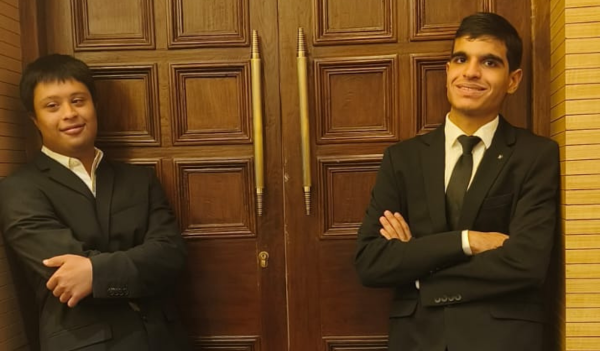
Caption: (From L to R) Mihaan and Vir.
Both boys are neurodivergent, with different needs and personalities. Vir has autism and Mihaan has Down Syndrome. Their mothers were trying to help them find stable friendships, something which proved to be far more challenging than finding a school or arranging therapies.
Moneisha’s son, Mihaan, went to a mainstream school and had an active social life. But things changed when he was about to finish school. “As he grew older, I realised his path would diverge from his neurotypical classmates. They would go to college, while he was on a modified curriculum. I started worrying that he would suddenly have no friends once school ended.” She then tried to find a community through Facebook groups but the attempts just “fizzled out.”
Gopika had a different, but equally difficult path. Autism shaped how her son, Vir, communicated. And rigidly structured play dates did not help him connect with others his own age. “He used to be very reticent, and it was hard for him to open up to a new child every time,” she said. Sports coaches turned Vir away and bullying incidents pushed Gopika into constant explanations and damage control.
Moneisha reached out to Gopika through Mihaan's paediatrician and eventually arranged a meeting between the boys. It took several facilitated attempts before the friendship settled, but it did settle. Mihaan appreciated Vir’s meticulous LEGO models; Vir appreciated not having to initiate every interaction. Their bond grew naturally without the clinical structure of play therapy or the anxiety of starting over each time.
Seeing this, the mothers recognised a broader issue: if forming one friendship required this much effort and luck, something was missing at a structural and a community level.
Communities are formed when people take part in simple, consistent shared activities that allow them to meet one another, build trust, and participate in everyday tasks together. “For many people with disabilities, exposure to social environments is limited. That means fewer chances to practise communication, negotiation, compromise, and conflict resolution — things neurotypical people learn through everyday interactions,” said Gopika of the philosophy behind Buddy Up.
But the idea of community extends far beyond companionship. A study from 2017 found that people with disabilities often report better quality of life when they have friends who share the same diagnosis. These insights align closely with what Gopika and Moneisha saw in their sons.
Friendships helped them navigate real‑life interactions. Like Moneisha said, “As parents, we even found ourselves happy when the boys had disagreements, because it meant they were experiencing real social interactions and were not being protected with kid gloves.” With their sons’ friendship as a guide, the two mothers explored ways to create similar opportunities for others. Their first attempt, a Facebook group, did not gain traction. Then, they explored building a website or an app.
After several rounds of research, they created Buddy Up. When the app was launched, Gopika and Moneisha expected parents to use it for their children. But this didn’t happen at scale. Instead, they saw a surprising outcome. “Adults with disabilities began using it. Connecting [with each other], forming friendships, and even seeking love,” said Gopika. This growing and unexpected user base has influenced subsequent development of the app. Features like options to choose whether you’re looking for friendship, love, or both, have been added in response to how people are using the app rather than predefined assumptions.
It’s no accident, then, that accessibility is central to how the app has evolved. Features like compatibility with screen readers, among others, address specific barriers raised by users. Interest tags have also been added over time to allow searches based on disability, hobbies, or skills. These additions follow requests from users who want more precise ways to find others. Safety considerations also affect how certain features are implemented. For example, video calling remains limited because of safety verification.
The app also allows users to select gender categories that include options beyond male and female. Users can also identify LGBTQ+ issues as interests. Moneisha stated that this helps people “with shared experiences find each other,” particularly when disability intersects with gender or sexuality.
Inside the app, community conversations grow on their own. Users debate, disagree, apologise, create groups, and share opportunities. Currently, the app has more than 15 active communities that have emerged organically.
These include groups for people with specific disabilities—such as autism, ADHD, cerebral palsy, visual impairment, deaf and hard‑of‑hearing users—as well as interest‑based circles like writers’ collectives, musicians’ groups, language‑learning spaces, and forums for gamers and hobbyists. There are also supportive environments focused on anxiety, social challenges, and relationship conversations, along with practical groups where users share job leads, accessibility tips, and peer guidance. None of these were created by the founders; they emerged from the users’ needs.
The app does not restrict participation to people with disabilities. The emphasis is clear: Buddy Up is disability‑friendly, but not disability‑exclusive. People without disabilities can join if they are looking for a community. “We want the app to feel welcoming to people without disabilities as well,” Moneisha said, reflecting feedback from users who want mixed communities.
To emphasise the ways in which Buddy Up is connecting users with disabilities, in our conversation with her, Moneisha referenced a non‑speaking autistic woman in Bangalore who used the app to connect with another autistic woman who was living nearby. These interactions occurred through search filters and community groups rather than through organised outreach.
It’s an anecdote that mirrors the same need the founders identified in their sons and one that I recognise from my own childhood: access to consistent, meaningful social contact.
The emotional and practical value of friendship often becomes visible only when it is missing. My own childhood had structure, discipline, and care. But it lacked kinship. That gap shaped how I understood myself, and how I interacted with others later in life.
Buddy Up sits squarely in that gap. It recognises that social development is not an add-on. It is an integral part of a person’s ability to move through the world. For many people with disabilities, especially those who did not have these opportunities when they were young, the app offers a chance to experience and embody the everyday interactions that others learn without thinking.
Check out Buddy Up here.
Communities are formed when people take part in simple, consistent shared activities that allow them to meet one another, build trust, and participate in everyday tasks together. “For many people with disabilities, exposure to social environments is limited. That means fewer chances to practise communication, negotiation, compromise, and conflict resolution — things neurotypical people learn through everyday interactions,” said Gopika of the philosophy behind Buddy Up.
